Neutrons, X-Rays and Positrons for Studying Microscopic Structures and Dynamics
Beschrijving
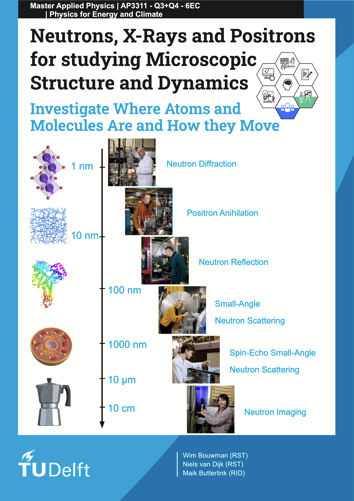
The microscopic structure and dynamics of condensed matter in physics, chemistry and biology is obtained by a wide variety of scattering techniques. Structures are determined on length scales ranging from 10-11 to 10-5 m, dynamics on time scales from 10-14 to 10-6 s. In this course we discuss the different neutron, X-ray and positron techniques, illustrated by a broad range of scientific and technological applications, for which recent scientific articles will be studied.
After a general introduction an overview is given of the scattering theory, both for neutrons and X-rays. Then the different techniques will discussed in more detail. Diffraction (either by X-rays or neutrons) yields information about the structure of single crystals, powders, and liquids. Small-angle scattering (SAXS and SANS) reveals the shape and arrangement of colloidal systems, micelles or polymers in a solvent. Reflectometry is used to find the composition of layered structures like proteins adsorbed at surfaces or magnetic layers in recording materials. Polarized neutrons are used in two different ways. First, for determining magnetic structures and dynamics. Second, as a special technique (spin-echo) to study the larger length scales and time scales (polymer dynamics). Inelastic scattering measures phonons in crystals, diffusion in liquids and the vibrational spectrum of molecules. Neutron sources (fission and spallation), X-ray sources (from X-ray tube, via synchrotron to XFEL) and instrumentation will be an integral part of this course.
An introduction to positron annihilation (PA) will be given. Positron annihilation lifetime, Doppler Broadening techniques are particularly suited for the detection and characterisation of (open volume) defects such as vacancies, vacancy clusters and voids in e.g. metals, alloys, semiconductors and polymers. The main application of the Angular Correlation of Annihilation Radiation (ACAR) technique is the study of the electronic structure of solids, and that of defects, precipitates and nanocrystals.
A visit to the neutron and positron experimental facilities at the Reactor Institute Delft will be part of the course.
Toetsing
Having done at least 11 of the 13 times homework is a requirement for taking the oral exam. The oral exam of 45 minutes determines the final grade. The student proposes and article or scientific topic connected to the course for the first 15 minutes of the exam.
Reviews0 reviews
Heb jij dit vak gevolgd?
Deel je ervaring met toekomstige studenten. Inloggen met je TU Delft mailadres duurt één minuut.
Schrijf een review