Physics of Biological Systems
Beschrijving
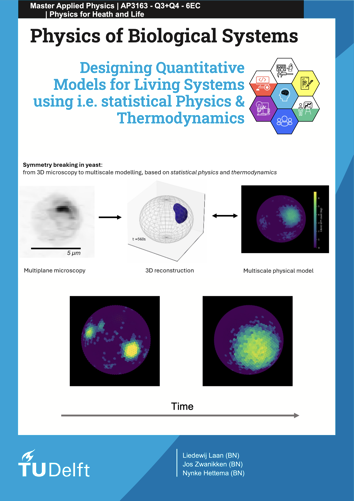
This is a course intended for physicists, biologists and engineers who are fascinated by the question: "What is life?" How does a collection of molecules that are governed by the laws of physics execute all the functions necessary to be alive?
If you are a physicist and have wondered why so many physicists are entering biology, this course will hopefully answer your question in depth. If you are a biologist fascinated by physics this course will show you the basic principles and methods. You do not need prior knowledge from biology or physics (rather you need a willingness to learn), however you need to have basic knowledge of solving ordinary differential equations. You will also need to program, but if needed we will help you to obtain the necessary programming skills.
Specifically you will learn how to apply different fields of physics, such as statistical physics, thermodynamics and information theory to solve biological questions, such as: how does a cell know where to divide, how does a cell know its destiny, how does a cell make decisions,...? You will answer these questions using mathematical models grounded in physics, using both analytical and computational methods.
One part of the course will be mostly dedicated to mathematical and theoretical aspects, while in the other part of the course we focus more on how you can test these theories using quantitative data-analysis and biophysical techniques.
The course aims to cover the following topics: cytoskeletal dynamics, material properties of living matter, noise in development and pattern formation inside cells, in combination with contemporary biophysical techniques.
Students will explore results of cutting edge, modern research, where novel experimental or theoretical approaches are used to investigate central questions in biology. Students will in groups work on an assignment where they are given experimental or simulated data and are challenged to develop and answer a research question using physical models such that they can directly apply they knowledge they obtained in the course.
Toetsing
The final grade for the course will be determined as follows, 50% of the grade comes from a research report and 50% from the final exam.
Within the report the points are distributed as follows:
report describing a research study you perform in groups of 3-4 students, where you (1) formulate a research question based on data provided by the lecturer and (2) analyse and interpret the data to answer your research question using physical models (60%);
a peer review of 3-4 reports by other groups of students (15%);
a presentation of your research study including a discussion of the peer reviews you received (20%)
a revised scientific report (5%) for your peers.
In order to pass this course,
students must obtain at least a passing grade (5,8) on the final exam and an overall grade of 5,8.
students need to have handed in a report, peer reviews, have given a presentation and revise their scientific report.
Reviews0 reviews
Heb jij dit vak gevolgd?
Deel je ervaring met toekomstige studenten. Inloggen met je TU Delft mailadres duurt één minuut.
Schrijf een review