Optics for Lithography
Beschrijving
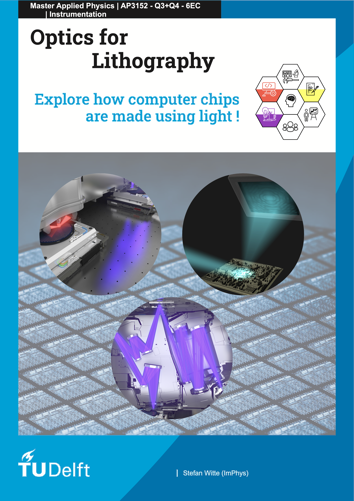
In this course, the students will deep-dive into the fascinating world of optical lithography, which is the key component of integrated circuit (IC) manufacturing in the semiconductor industry. The technology of IC is ubiquitous in todays connected world with smartphones and tablets. The societal need for being connected via digital technology has become part of our daily lives: working from home, on-line meetings, teaching via on-line courses, and all digital social contacts are enabled by advanced computing capabilities made possible by lithography. It is exciting to realize that optics and optical imaging theory are key enabling technology in such a high-end industrial application as the lithographic scanner. The main technological aspects used in optical lithography will be discussed throughout the lectures.
The primary ambition of this course for the student is to get in touch with a variety of optics-related technologies that are needed in the semiconductor industry. This first contact may trigger new interesting perspectives for the student who aims at:
Starting a PhD-project in optics, imaging physics or a topic related to semiconductor manufacturing
Pursuing a career in the semiconductor industry in one of the leading companies or institutes in this field (ASML, TNO, Zeiss, IMEC, VSL, PTB)
Major topics that will be addressed are:
Diffraction theory and its application to lithography
Imaging theory and Fourier optics (aerial image formation; and image formation in photo resist)
Imaging optics (for a DUV litho-scanner (at wavelength of 193 nm); and for an EUV litho-scanner (at wavelength of 13.5 nm))
Mask technology
Optical wafer metrology inside the lithographic scanner (for leveling and alignment)
Optical wafer metrology outside the lithographic scanner (for overlay and profile)
Physics of the light sources, especially the laser-produced plasma source for EUV
Recent developments towards future scanner technology, including the R&D process for the Next Generation High-NA EUV Lithographic Scanner
Finally, we conclude the course with a visit to the Experience Center of ASML in Veldhoven.
Toetsing
The course assessment is divided into three parts:
(1) Written examination (both for Exam (1st examination) and Resit (2nd examination)): weighing 50%
(2) Assignments-during-Course (given at the end of three pre-defined sessions; results to be submitted within two weeks): weighing 30%
(3) Final Assignment (given at the end of the course; results to be submitted before the Exam (1st examination)): weighing 20%
The results obtained for the assignments-during course and the final assignment are only valid for the year in which they were obtained, as well as the following academic year. The weighing of these partial results is done following the rules of the year in which they were obtained.
Reviews0 reviews
Heb jij dit vak gevolgd?
Deel je ervaring met toekomstige studenten. Inloggen met je TU Delft mailadres duurt één minuut.
Schrijf een review